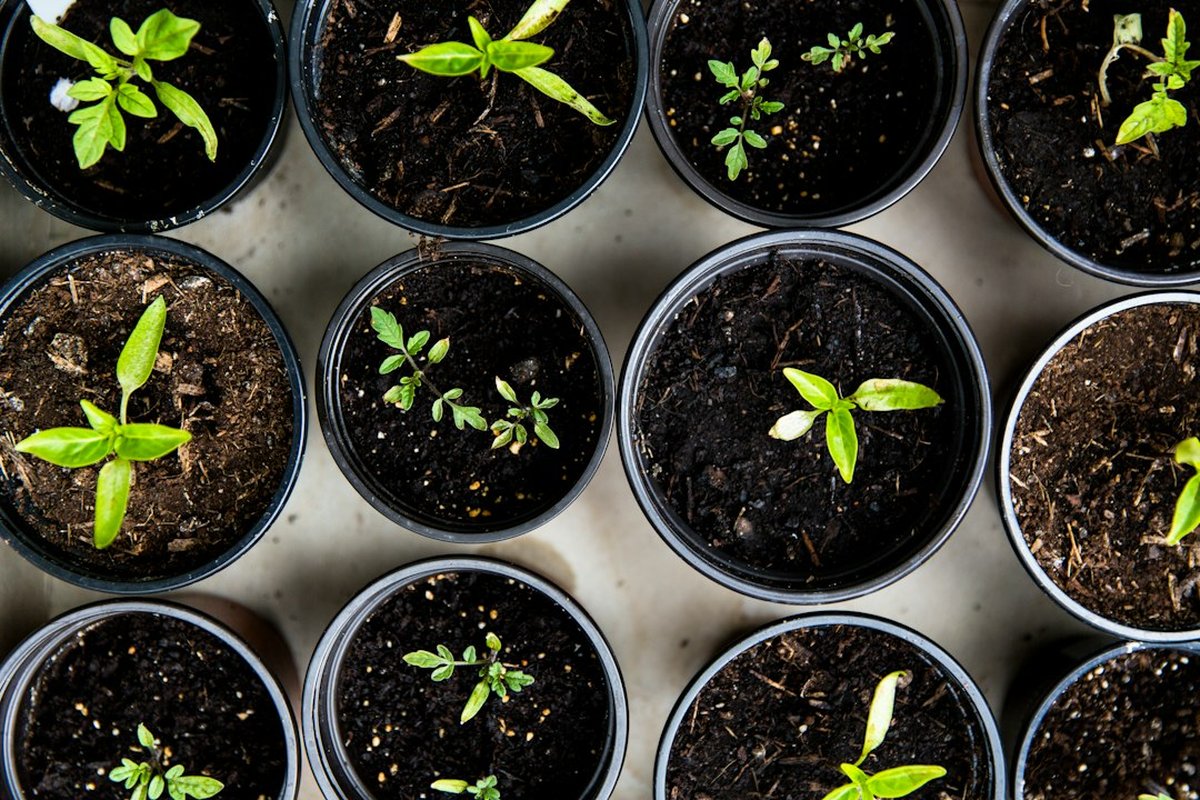
How big a pot does a vegetable need? For fruiting plants such as tomatoes, peppers, eggplant and cucumbers, the extension services agree on 5 gallons as the floor. Leaf lettuce, radishes and beets get by on well under 2 gallons. Full-size tomatoes and summer squash do better at 10 gallons or more.
The numbers differ from source to source because some publish the smallest pot a plant will survive in and others publish the size it does well in. The chart below gives both. Where one extension says something different from another, it names each of them.
Container sizes, crop by crop
The second column shows the per-plant minimums from two extension crop tables: University of Maryland Extension (updated September 10, 2026) and Virginia Cooperative Extension Publication 426-336. The third column comes from a second UMD page, Types of Containers for Growing Vegetables, which sorts crops into small, medium and large groups and gives a depth for each group. The last column shows what other published guides recommend.
| Crop | Per-plant minimum (UMD; Virginia Tech) | UMD size group: volume and depth | Other published figures |
|---|---|---|---|
| Leaf lettuce | 1/2 gal; 1/2 gal | Small: 1 to 3 gal, 4 to 6 in | 1 to 3 gal (Old Farmer's Almanac); 2 gal minimum, 3 better (Growing In The Garden) |
| Radishes | 1 pint; 1 pint | Small: 1 to 3 gal, 4 to 6 in | 8 in wide, 6 to 8 in deep (New York Botanical Garden) |
| Basil, thyme | 2 to 5 gal (UMD) | Small: 1 to 3 gal, 4 to 6 in | 10-inch pot for herbs (Oregon State); basil 2 gal minimum, 3 better (Growing In The Garden) |
| Beets | 1/2 gal; 1/2 gal | Medium: 4 to 6 gal, 8 to 12 in | 2 to 5 gal for root crops (Old Farmer's Almanac) |
| Carrots | 2 gal; 1 quart | Medium: 4 to 6 gal, 8 to 12 in | Short 1 to 2 gal, medium 5 gal, long 10 gal (Harvest to Table) |
| Bush beans | 2 gal; 2 gal | Medium: 4 to 6 gal, 8 to 12 in | 10 gal (Harvest to Table) |
| Peppers | 5 gal; 2 gal (bell) | Large: 8 to 10 gal, 12 to 16 in | 14-inch-wide pot (Penn State); 5 gal minimum, 7 to 10 better (Growing In The Garden) |
| Eggplant | 5 gal; 5 gal | Large: 8 to 10 gal, 12 to 16 in | 14-inch-wide pot (Penn State); 5 to 10 gal (Harvest to Table) |
| Cucumbers | 5 gal; 5 gal | Large: 8 to 10 gal, 12 to 16 in | 7 to 10 gal (Harvest to Table); at least 12 in deep (Old Farmer's Almanac) |
| Summer squash | 10 gal (UMD) | Medium: 4 to 6 gal, 8 to 12 in | 12 to 18 in pot for zucchini (Harvest to Table) |
| Tomato, full-size | 5 gal; 5 gal | Large: 8 to 10 gal, 12 to 16 in | Determinate 5 to 10 gal, indeterminate 15 to 25 gal (Old Farmer's Almanac); 20-inch-wide pot (Penn State) |
Depth matters as much as volume. Virginia Cooperative Extension says most vegetables need at least 6 to 8 inches of soil. Harvest to Table says 8 inches will support a good yield from almost every vegetable and herb. Penn State adds a simple shape rule: a pot should be at least as tall as it is wide.
Why the sources give different sizes
Most of the disagreement is minimum versus comfortable. Virginia Tech's table is the most permissive. It lists a 2-gallon bell pepper and a 1-quart carrot, and those are the smallest pots the plant will finish in. Growing In The Garden, run by horticulturist Angela Judd, publishes a minimum and a better size for each crop. For peppers that is 5 gallons, and 7 to 10 gallons does better.
The other cause is grouping. UMD's own two pages don't match. Its crop table gives summer squash 10 gallons, the largest figure in that table. Its size-group page puts summer squash in the medium group at 4 to 6 gallons. The group page is a sorting shortcut, so when a single crop's figure differs from its group's range, follow the single crop's figure.
No source here compared yields from the same crop in different pot sizes, so none of them shows how much harvest a gardener loses by going smaller. The minimums are expert judgment, not measured cutoffs. A trial that grew one variety in 2, 5 and 10 gallons would settle it. Until then, treat the smallest number as a floor, not a target.
Tomatoes split into two sizes
Tomatoes have the widest range in the chart because "tomato" covers two different plants. A determinate tomato grows to a set height and stops. An indeterminate tomato keeps growing and fruiting all season. The Old Farmer's Almanac chart gives determinate types 5 to 10 gallons and indeterminate types 15 to 25 gallons.
The extension figures of 5 gallons per plant fit a determinate or compact variety. For a sprawling indeterminate slicer, the larger published figures make more sense: 10 to 20 gallons from Harvest to Table, and at least a 20-inch-wide pot from Penn State. If you haven't chosen a variety yet, the difference in staking and container suitability is worth settling before you buy the pot.
Cherry tomatoes need the least room. UMD lists them at 2 gallons and Virginia Tech at 1 gallon.
Root crops are sized by what grows underground
For carrots, the variety's root length sets the pot. Harvest to Table splits carrots into three tiers: short varieties in 1 to 2 gallons, medium in 5, and long in 10. None of the sources gives an inch-by-inch depth for each carrot length. The practical rule is that the soil should be deeper than the root the seed packet describes, with UMD's 8 to 12 inches for its medium group as a starting range.
Potatoes have the biggest spread in the whole list. UMD's size-group page calls for a 30-gallon container. The Old Farmer's Almanac gives 10 to 30 gallons and Harvest to Table gives 5 to 20. Both of those ranges depend on how many potatoes you want. So a 10-gallon container grows potatoes by two of three sources, but it is a third of what UMD recommends. Expect a smaller harvest from it, not a failed one.
How many plants go in one pot
The volumes above are for one plant. For crops that can share a pot, Virginia Tech gives the spacing between plants inside the container:
- Radishes: 1 inch
- Beets and bush beans: 2 to 3 inches
- Leaf lettuce and Swiss chard: 4 to 6 inches
- Kale: 10 to 15 inches
- Cabbage: 12 to 18 inches
- Cucumbers: 14 to 18 inches
Peppers, eggplant and tomatoes get one plant per container.
None of the sources turns spacing into a plant count for a given pot. Work it out from the pot's top surface. A container 12 inches across holds lettuce at 6-inch spacing about two plants wide. For cucumbers, the same pot has room for only one.
Shallow crops can also go in something wider than a pot. UMD's salad table is a raised frame 58 inches long, 33 inches wide and only 3.5 inches deep, holding about 22 gallons of potting mix, and it is built for greens and short roots. For taller crops that need more soil, a raised bed is the next step up. Penn State says corn, watermelon, winter squash and zucchini are better grown in the ground than in containers.
A bigger pot means less watering
A small pot dries out quickly because it holds less soil, so it stores less water. It works like a small water bottle on a hot day: it runs out sooner.
Angela Judd of Growing In The Garden puts it directly:
A larger container holds more soil, which means it dries out more slowly and gives roots more room to grow.
She recommends against containers holding less than 2 gallons of soil for most vegetables grown to maturity, and suggests the largest practical container in hot climates. Harvest to Table gives one benchmark: a standard 8-inch-deep container needs water roughly two to three times a week. None of the sources measured how much a 10-gallon pot cuts that, so the direction is well established and the exact saving is not.
The container material changes the rate too. UMD Extension notes that porous materials (clay, ceramic, concrete and wood) dry out faster than plastic or metal. The New York Botanical Garden guide recommends self-watering containers, which have a built-in reservoir the plant draws from, for thirsty crops like tomatoes. When you do water, Virginia Tech's rule is to apply water until it runs out the drainage holes.
Matching a grow bag label to the chart
Oregon State University Extension lists fabric grow bags among the containers that work, as long as they drain well. Fabric bags are often named by volume, as in VIVOSUN's 5 Gallon Grow Bags. That means you can read the gallon figure on the listing straight against the chart.
A 5-gallon bag covers the extension minimum for a pepper, an eggplant, a cucumber or a determinate tomato. It also holds a few lettuce or beet plants at Virginia Tech's spacing. A 10-gallon bag fits summer squash, long carrots, an indeterminate tomato at the low end of Harvest to Table's range, and potatoes at the low end of the Almanac's. The sources here don't publish depth or diameter for VIVOSUN's bags, so check the listed dimensions against the depth column before ordering for deep-rooted crops.
Whatever you buy, drainage is required. UMD says every container must let extra water drain out so roots don't drown and rot. It also says gravel at the bottom creates drainage problems instead of solving them. Raise the pot on bricks or pot feet.
If you want one rule
Buy 5 gallons as the smallest pot for anything that fruits. That is where UMD, Virginia Tech and Oregon State agree for tomatoes, peppers, eggplant and cucumbers. Go to 10 gallons or more for full-size and indeterminate tomatoes, summer squash, long carrots and potatoes. For lettuce, herbs and radishes, a 2-gallon pot at least 6 to 8 inches deep is enough, and buying bigger mostly buys you less watering.
When a crop falls between two sizes, choose the larger one. The smaller figures in these tables describe what a plant survives in. No published source reports a vegetable doing worse because its pot was too big.
Comments
No comments yet. Be the first to comment!
Leave a Comment