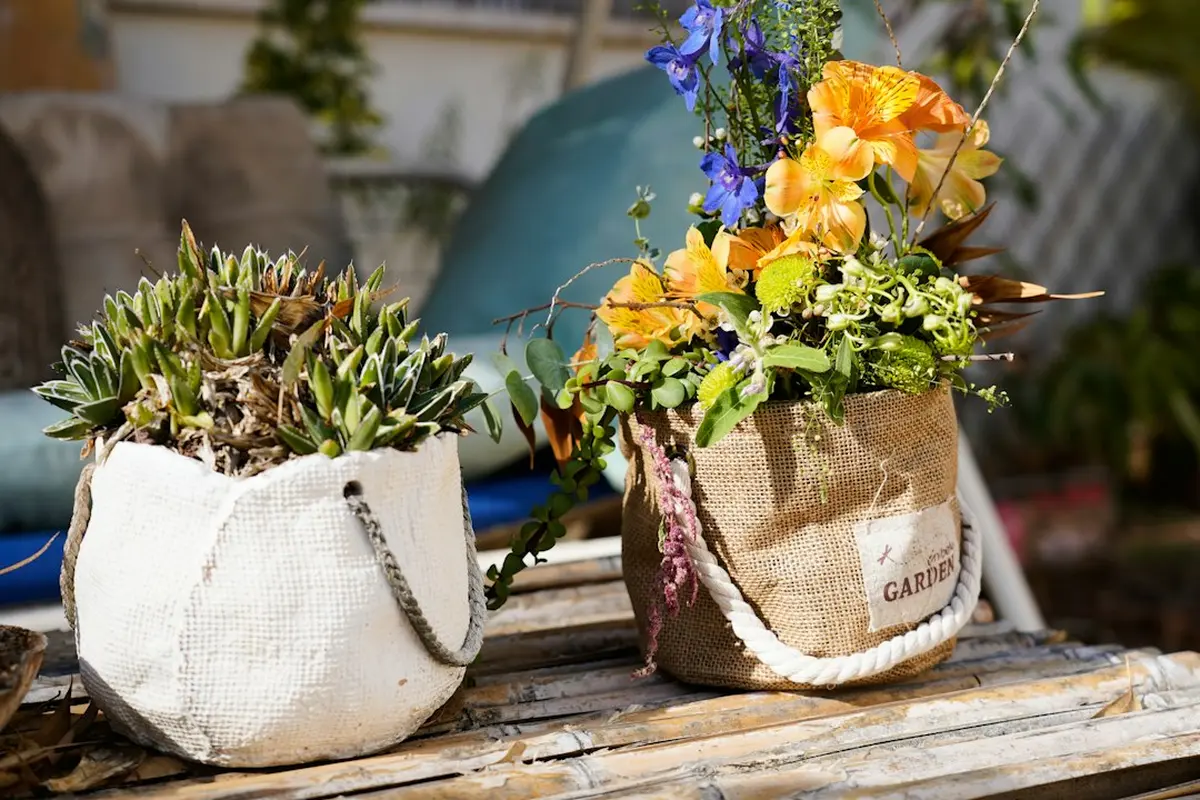
You have a patio, a balcony or a stretch of driveway, no garden bed, and you want to grow something you can eat. You can: lettuce, herbs, bush beans, peppers and compact tomatoes all grow well in pots, as long as the spot gets enough sun and you water more often than you expect. This page takes you from an empty spot to a first planted container, and tells you what to grow after that.
It is written from extension-service guidance (Penn State, Oregon State, Maryland, Minnesota, Virginia Tech, Illinois and Rutgers). Where those sources disagree, the page says so.
A container is a small, closed box of soil
Almost every rule in container gardening comes from one fact: a plant in a pot can only use the soil and water inside the pot.
A tomato in the ground can push roots down and reach moisture well below the surface. University of Minnesota Extension notes that deep-rooted crops like tomatoes, squash and melons can draw on those deeper reserves. The same tomato in a pot cannot. When the pot dries out, the plant has nothing else to draw on.
That single limit explains the rest of this page:
- Watering is frequent. The same Minnesota educators put it without qualification: "Container vegetables require daily watering."
- Feeding is regular. Each watering washes nutrients out of the small volume of soil, so they have to be replaced.
- The soil has to be special. Garden soil packs down in a pot and stays wet. A pot needs potting mix, a light, bagged growing medium made mostly from materials such as peat or sphagnum moss, composted bark, coconut coir, perlite and vermiculite, which drains fast but still holds water.
- Pot size matters. A bigger plant needs a bigger box.
If you remember that the pot is the plant's whole world, you can work out most of the other rules yourself.
What you need before you start
The list is short. The extension sources used here do not give prices, so this page does not either. Setting up one container takes an afternoon. The real time commitment is afterward: a few minutes a day of checking and watering, every day, for as long as the plant is growing.
-
A spot with enough direct sun
Leafy crops such as lettuce, spinach and Asian greens can succeed with 3 to 5 hours of direct sun, according to University of Maryland Extension. Fruiting crops (tomatoes, peppers, eggplant, squash, beans) need 6 to 8 hours.
-
A water source close by
Maryland Extension calls easy access to water essential when choosing where the containers go. A watering can works for a few pots. A hose with a wand attachment is easier for more than that.
-
Containers with drainage holes
Every source is firm on this point. The size you need depends on the crop; see the table below.
-
Bagged potting mix
Look for a mix that lists perlite or vermiculite, the ingredients Oregon State Extension names for drainage. Do not use garden soil, topsoil or anything labeled planting mix.
-
An all-purpose fertilizer
Choose one that contains nitrogen, phosphorus and potassium. Some potting mixes contain no fertilizer at all, as University of Illinois Extension points out, so read the bag.
-
Bricks, boards or wooden slats
These lift pots off concrete so water can drain freely.
Which material? Penn State Extension sets out the trade-offs:
- Plastic is light and holds moisture well.
- Terracotta is porous and dries out quickly.
- Cement or stone is heavy, which keeps a top-heavy tomato from tipping over.
Improvised containers also work if water can drain out of them. Oregon State lists bushel baskets, plastic tubs, wooden boxes, gallon cans and rinsed jugs with the top cut off. If you have to drill holes yourself, put them about half an inch above the bottom.
Self-watering containers hold a water reservoir under the soil and catch runoff. Maryland recommends them, or a plastic saucer, where drips would stain a wood deck or concrete.
Fabric grow bags are popular, but none of the extension sources here compare them with rigid pots. The same rules apply to anything you plant in: enough volume for the crop, and a way for water to leave.
Weight. Before you set a pot on a balcony, know that Maryland puts a filled 20-inch container at about 100 pounds. Fill large containers where they will stay.
Plant one pot of lettuce this fall
It is late October, so the right first crop is a cool-season one. Lettuce needs the least sun, the smallest pot and the least time. Virginia Cooperative Extension lists it as maturing in 30 to 35 days.
One caution first. None of these sources give first-frost dates, and those vary widely across the country. Check your own local average before you plant. In mild-winter areas, fall is prime time for greens. In cold ones, frost may already have arrived or be only days away. Radishes are an even faster alternative: 25 to 35 days in a pot as small as a pint.
-
1. Count the hours of direct sun on your spot
Check it every hour or two across one day. Three to five hours of direct sun is enough for lettuce. You have it right when you can name the hour the sun arrives and the hour it leaves.
-
2. Choose a container at least 6 to 8 inches deep with drainage holes
Virginia Tech gives 6 to 8 inches as the minimum depth for root growth. Illinois Extension says a one-gallon container holds 4 to 6 leaf lettuce plants. Pour water through the empty pot: it should run straight out the bottom.
-
3. Moisten the potting mix before it goes in
Oregon State recommends this step. The mix should feel damp all the way through, like a wrung-out sponge, with no dry pockets.
-
4. Fill to within 1 inch of the rim
That inch is a reservoir. When you water, it fills and then soaks in instead of spilling over the edge.
-
5. Plant your lettuce 4 to 6 inches apart
This is Virginia Tech's spacing. In a one-gallon pot, that usually means four to six plants arranged around the pot.
-
6. Water until it drains out the bottom
Water thoroughly right after planting. You have watered enough when water comes out of the drainage holes.
-
7. Raise the pot on bricks or slats
This matters most on concrete. Water should drip freely from underneath and never pool around the base.
-
8. Check the soil every day
Push a finger into the mix. Water when the top 1 to 2 inches feel dry, which is Oregon State's test. Empty any saucer afterward so the roots are not sitting in water.
-
9. Start feeding 2 to 6 weeks after planting
This is Minnesota Extension's window. Use your all-purpose fertilizer at the rate on the label. The leaves should stay an even green.
-
10. Harvest outer leaves as they reach usable size
Pick the outer leaves and leave the center to keep growing.
If you are reading this in spring
Spring is the season for warm crops: bush beans, peppers, eggplant, and determinate or dwarf tomatoes. A determinate tomato grows to a set size, fruits, and stops. That makes it far more manageable in a pot than a vining type that keeps growing all season. The differences, and how to choose, are laid out in our comparison of determinate and indeterminate tomatoes. Penn State recommends varieties labeled dwarf or determinate for containers.
The method is the same as for lettuce, with two changes. The spot needs 6 to 8 hours of sun, and the pot has to be larger.
On tomato pot size, the sources genuinely disagree:
- Illinois says 3 gallons for a standard tomato.
- Oregon State and Virginia Tech say 5 gallons.
- Penn State says a container at least 20 inches wide.
The gap probably reflects different varieties and climates. No source here tested them side by side, so start at the larger end. A pot that is slightly too big costs you some potting mix. A pot that is too small costs you the plant.
Penn State adds that a container should be at least as tall as it is wide.
| Crop | Container size | Direct sun | Source |
|---|---|---|---|
| Radishes | 1 pint | Partial shade tolerated | Virginia Tech |
| Leaf lettuce | 1/2 gallon; or 4 to 6 plants per 1 gallon | 3 to 5 hours | Virginia Tech, Illinois, Maryland |
| Herbs, parsley, green onions | 10-inch pot | Varies by herb | Oregon State |
| Green beans | 2 to 3 plants per 1 gallon | 6 to 8 hours | Illinois, Oregon State |
| Cherry tomato | 1 gallon | 6 to 8 hours | Virginia Tech, Illinois |
| Peppers | 2 gallons minimum; 14-inch pot | 6 to 8 hours | Virginia Tech, Penn State |
| Kale | 5 gallons | Partial shade tolerated | Virginia Tech |
| Standard tomato | 3 to 5 gallons; 20 inches wide | 6 to 8 hours | Illinois, Oregon State, Penn State |
What to skip. Rutgers states that sweet corn and watermelons do not adapt to containers. Maryland rates melons, corn, potatoes and sweet potatoes as more demanding. These are not impossible, but they are poor choices for a first year.
What goes wrong the first time
Filling the pot with yard soil. Penn State, Oregon State and Minnesota all warn against it. Garden soil compacts in a pot, drains poorly and can carry weed seeds and disease. How to tell: water sits on the surface long after you pour it, and the soil sets hard when it dries. What to do: start over with bagged potting mix. If you want more water-holding capacity, you can blend in finished compost, up to 50 percent of the total according to Penn State.
Roots sitting in water. A pot with no holes, or a full saucer left in place, drowns the roots. Minnesota Extension adds that waterlogged mix loses nitrogen. How to tell: the mix stays soggy for days and the plant wilts even though it is wet. What to do: add holes, raise the pot, and empty saucers after every watering.
A pot that is far too big causes a quieter version of the same problem. Oregon State's Amy Jo Detweiler warns that too much unfilled space holds excess water and encourages root rot. Match the pot to the crop using the table above.
Watering on a schedule instead of by touch. Containers dry out much faster than beds. Rutgers says pots may need water 2 to 3 times a day in hot weather.
This fall is a live example. The U.S. Drought Monitor summary released September 24, 2026 had southern states running 5 to 10°F above normal, with extreme drought stretching from southern Virginia to central Florida. At the same time, parts of the Upper Midwest got 6 to 8 inches of rain in places.
How to tell you are behind: leaves flag by afternoon, and the mix has pulled away from the sides of the pot. What to do: check every morning. In heat, check again in the evening. A layer of mulch on top of the mix (straw, shredded newspaper or coconut coir) cuts evaporation.
Planting too much at once. Maryland's advice for a first year is plain: start small. Ten pots means ten daily checks. Two or three pots is a routine you will actually keep up.
After the first pot works
Once you are harvesting lettuce, you have learned the part that matters: watering by touch and feeding on a rhythm. Three directions follow naturally from there.
Keep the greens coming. Illinois suggests sowing leafy greens every 1 to 2 weeks for a continuous harvest. This is called succession planting: staggered sowings so that one batch matures as the last one runs out.
Plan one fruiting crop for spring. Pick a pepper or a determinate tomato for your sunniest spot and a pot at the large end of the range.
Feeding matters more for fruiting crops. Penn State's approach is a slow-release fertilizer mixed in at planting, then a soluble fertilizer every 2 to 4 weeks. Oregon State's alternative is a half-strength liquid fertilizer every 3 to 4 days. Both approaches exist because repeated watering keeps washing nutrients out of the pot. Minnesota suggests a fertilizer higher in phosphorus or potassium for fruiting plants, applied at label rates, because too much damages them.
Tomatoes will also need a 2 to 4 foot stake or a wire cage, per Illinois.
Reuse the containers through the year. Oregon State notes that after spring and early-summer harvests, the same pots can be replanted with late-summer and fall vegetables.
If you find you want more room than a patio allows, a raised bed with its own soil mix is the usual next step, and many of the same principles carry over.
Comments
No comments yet. Be the first to comment!
Leave a Comment