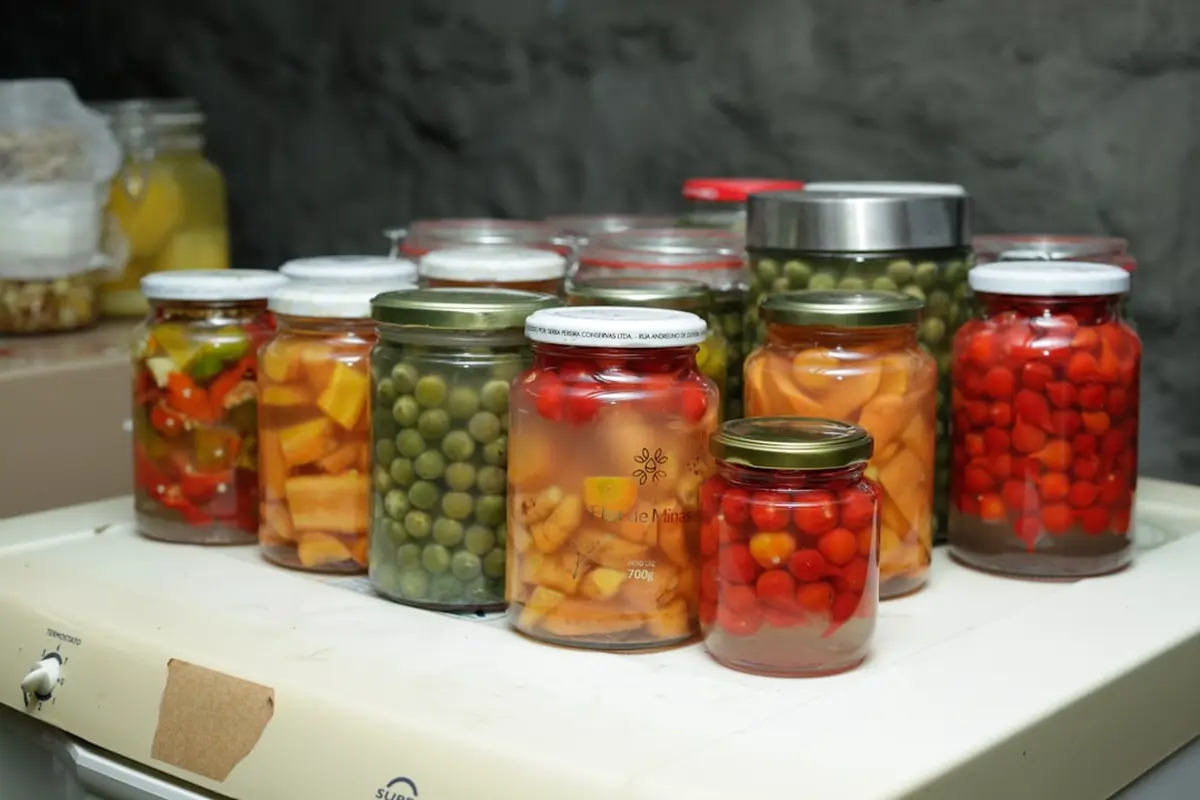
Fermenting vegetables at home means packing cut or whole vegetables with salt, keeping them under liquid, and letting bacteria that already live on them turn their sugars into acid. At a comfortable room temperature that takes about three to four weeks, and the result is sauerkraut, sour pickles, or a jar of tangy carrots that keeps for months in the refrigerator. You need no starter culture and no canner, only a vessel, salt, a weight, and patience.
This page is for gardeners with more cabbage, cucumbers, carrots or radishes than they can eat fresh, and for anyone who has tried a batch and wondered whether the white film on top meant they had poisoned the household. (It almost certainly did not. More on that below.)
The thing most beginners get wrong is the salt. It looks like seasoning, so people cut it to taste. It is not seasoning. Salt decides which microbes get to grow in the jar, and the National Center for Home Food Preservation puts it bluntly: "Do not attempt to make sauerkraut or fermented pickles by cutting back on the salt required." Get the salt and the submersion right, and most of the rest takes care of itself.
What the salt, the brine and the weeks are doing
Fermentation, in the NCHFP's description on its fermenting hub, is microorganisms breaking down organic compounds in a low-oxygen environment and producing acids, alcohol and gases that preserve the food and change its flavor and texture. In vegetables the organisms that matter are lactic acid bacteria: microbes that eat sugar and give off lactic acid, the same sharp sourness you taste in good sauerkraut.
Think of the jar as a race. Every cabbage leaf carries a mix of microbes, some useful and some that cause rot. Salt and the absence of air tilt the race. Lactic acid bacteria tolerate salt and do fine without oxygen; many spoilage organisms do not. As the good bacteria multiply, they make the brine more acidic, and the acid shuts out the competition for good.
That is why the University of Minnesota Extension says "an anaerobic, low-oxygen environment is needed for the good bacteria to work," and why every source here insists the vegetables stay under the brine. A piece of cabbage poking above the surface is in air, and air is where mold grows.
The acid is also the safety mechanism. The NCHFP explains that a minimum, uniform level of acid throughout the product is what prevents growth of Clostridium botulinum, the bacterium behind botulism. The University of Minnesota Extension (guidance reviewed in 2026) treats a ferment as finished and safely acidified when its pH, a measure of acidity where lower numbers mean more acid, reaches 4.60 or lower and the bubbling has stopped. A fermentation troubleshooting guide from Ferment Foundry reports that well-made ferments usually finish lower still, between pH 3.2 and 3.7.
How safe is it in practice? Fermentation educator Holly Howe, at Make Sauerkraut, quotes USDA microbiologist Fred Breidt: "There has never been a documented case of food-borne illness from fermented vegetables." That is a strong record, but it is a quote relayed by a blog, not a published study, and it describes ferments made with proper salt and submersion. It is a reason for calm, not a reason to skip the rules.
Why weight beats tablespoons
Salt levels are given as a percentage of weight. Virginia Cooperative Extension's vegetable fermentation guide sets sauerkraut at 2.25 to 2.5 percent salt by weight, low-salt pickles at 3 to 5 percent, and high-salt pickles at 5 to 16 percent.
Tablespoons are easier, and extension guides do give them. The trouble, as Fermenting for Foodies points out, is that a tablespoon of fine salt and a tablespoon of coarse salt do not weigh the same, and vegetables differ in density, so the same spoonful gives a different concentration in shredded cabbage than in whole cucumbers. A kitchen scale removes the guesswork. If you do not have one, follow a tested recipe's volume measurements exactly and use the salt it names.
Two ways to get the vegetables under brine
There are two methods, and the vegetable decides between them. University of Illinois Extension describes dry salting, where you massage salt into shredded vegetables until they release enough juice to cover themselves, and brining, where you dissolve salt in water first and pour it over whole or quartered pieces.
| Dry salting | Brining | |
|---|---|---|
| Best for (University of Illinois Extension) | Shredded or finely cut vegetables, such as cabbage for sauerkraut | Whole or quartered vegetables, such as cucumbers, radishes or carrot sticks |
| Where the liquid comes from (University of Illinois Extension) | The vegetables' own juice, drawn out by massaging salt in for 10 to 15 minutes | Salt water you mix before packing |
| Salt level (Virginia Cooperative Extension; University of Illinois Extension) | 2.25 to 2.5% of the vegetable weight for sauerkraut | 3% brine for shredded pieces (1 quart water + 2 Tbsp, 27 g salt); 5% brine for whole or large pieces (1 quart water + 3 Tbsp, 45 g salt) |
| Classic product (NCHFP) | Sauerkraut | Fermented dill pickles |
| Time at 68 to 72°F (Virginia Cooperative Extension) | 3 to 4 weeks | 3 to 4 weeks |
Why does a whole cucumber need a stronger brine than shredded cabbage? Illinois Extension's reasoning is that large, dense pieces ferment more slowly, so spoilage organisms have longer to get a foothold, and the extra salt holds them off during that wait.
Making a batch, from cutting board to refrigerator
The process is the same for kraut, pickles and mixed vegetables. Only the salt figure and the size of the pieces change. Gather the following before you start cutting, because once the salt is on the vegetables, the clock is running.
-
A food-grade container
Glass, ceramic, or HDPE #2 plastic (Virginia Cooperative Extension). No metal (University of Minnesota Extension). Never a garbage bag or trash liner touching the food (NCHFP).
-
Something to hold the vegetables down
A dinner plate or glass pie plate slightly smaller than the opening, weighted with 2 to 3 sealed quart jars of water, or a sealed food-grade bag holding 3 quarts water plus 4.5 tablespoons salt so a leak will not dilute the brine (NCHFP). Small jars can use fermentation weights or a folded cabbage leaf.
-
Canning or pickling salt
No iodine, no anti-caking agents (Virginia Cooperative Extension; University of Minnesota Extension).
-
A kitchen scale
Salt targets are given as a percentage of weight.
-
A thermometer for the room
Virginia Cooperative Extension lists one as standard equipment, because temperature sets both speed and texture.
-
A cover
A clean, heavy bath towel over a crock to keep out insects and mold (NCHFP), or an airlock lid on a jar to limit oxygen (University of Illinois Extension).
-
Suitable water, if brining
University of Minnesota Extension recommends soft or distilled water to avoid discoloration and texture problems.
-
Fresh, firm vegetables
No soft spots or signs of spoilage (University of Illinois Extension).
On container size, two extension services disagree. The NCHFP's equipment page calls for 1 gallon of capacity per 5 pounds of vegetables, which is why a 5-gallon crock suits about 25 pounds of cabbage or cucumbers. University of Minnesota Extension lists 1 gallon per pound. The figures come from different recipes and nothing in the sources reconciles them; the NCHFP ratio is the one matched to its tested sauerkraut and pickle recipes, and either one leaves you room for the weight and the brine.
Fermenting vegetables at home, step by step
-
Clean the equipment
Wash the container, plate and weight jars in hot sudsy water and rinse with very hot water (NCHFP), or boil jars for 10 minutes (University of Illinois Extension). You do not need to sterilize the vegetables; Make Sauerkraut notes that sterilizing would kill the beneficial bacteria along with the harmful ones.
It worked when: everything is clean, rinsed free of soap, and ready to fill.
-
Prepare the vegetables
Rinse off dirt, but do not scrub: University of Minnesota Extension warns that scrubbing "may remove the good bacteria needed for fermentation." Shred cabbage, cut or leave other vegetables whole. For cucumbers, slice 1/16 inch off the blossom end, because the NCHFP says blossoms can carry enzymes that soften pickles.
It worked when: pieces are a consistent size, so they ferment at the same pace.
-
Weigh and salt
For dry salting, weigh the prepared vegetables and multiply by your salt percentage (see the worked example below). Toss the salt through and massage. For brining, mix 2 tablespoons salt per quart of water for shredded pieces or 3 tablespoons per quart for whole or large pieces (University of Illinois Extension).
It worked when: shredded vegetables are wet, limp and sitting in their own juice; brine salt is fully dissolved.
-
Pack and submerge
Pack the vegetables firmly into the container, pressing out air. Add juice or brine until the vegetables sit 1 to 2 inches below the surface (NCHFP; Virginia Cooperative Extension).
It worked when: no piece is above the brine line, and there is still headroom for the weight.
-
Weight and cover
Set the plate on top, add the water-filled jars or brine bag, and cover with a towel or fit the airlock lid. Keep the brine-filled bag method in mind for crocks: if it leaks, the liquid that escapes is brine, not plain water.
It worked when: pushing on the weight does not let anything float up around the edges.
-
Set it somewhere 68 to 72°F
That is the optimal range from Virginia Cooperative Extension, University of Illinois Extension and University of Minnesota Extension. Virginia Cooperative Extension accepts 60 to 78°F; out of direct heat is the goal.
It worked when: the room thermometer holds steady in range for the first week.
-
Watch the first week and a half
Make Sauerkraut singles out the first 7 to 10 days as the period when keeping vegetables submerged matters most. Ferment Foundry reports the most vigorous bubbling on days 2 to 5, and a cloudy, milky brine and clean sour smell within 3 to 5 days. Push down anything that floats and skim any surface film (see the next section).
It worked when: you see bubbles, cloudy brine and smell something sour rather than rotten.
-
Decide it is done
University of Illinois Extension's signs are bubbling activity, a sour smell, and the tang you want. University of Minnesota Extension adds the measurable test: bubbling has stopped and pH is 4.60 or lower.
It worked when: bubbling has quieted and the taste is properly sour all the way through.
-
Store it
Move the finished ferment to the refrigerator, where University of Minnesota Extension says it keeps up to 9 months, or process it in a boiling water bath for shelf storage (Virginia Cooperative Extension; University of Illinois Extension). Freezing also works and University of Minnesota Extension says frozen fermented produce keeps indefinitely.
It worked when: jars are lidded, labeled with the date, and cold.
How much salt for a gallon jar of sauerkraut
Say you core and shred two heads of cabbage and the scale reads 1,600 g, about 3.5 pounds. Virginia Cooperative Extension's target for sauerkraut is 2.25 to 2.5 percent salt by weight.
| Shredded cabbage | 1,600 g |
|---|---|
| Salt at 2.25% (1,600 × 0.0225) | 36 g |
| Salt at 2.5% (1,600 × 0.025) | 40 g |
| Container at NCHFP's 1 gallon per 5 lb | About 0.7 gallon, so use a 1-gallon jar |
Weigh out 36 to 40 g of pickling salt. Make Sauerkraut gives 1 tablespoon as about 16 g for its salt, so that is roughly 2¼ to 2½ tablespoons, but coarse salts measure differently by volume, which is why the scale is the better tool.
Beginner recipes for the fall harvest
Extension services repeat one rule above all for recipes: use ones with tested proportions. The three below are either tested recipes from extension sources or built strictly on extension salt figures.
Crock sauerkraut, the tested big batch
The UNH Extension recipe (September 2025) uses 25 pounds of cabbage and 3/4 cup of canning or pickling salt and yields about 9 quarts. Twenty-five pounds is exactly what the NCHFP says a 5-gallon stone crock holds.
Shred, salt in layers as you pack, press down until juice covers the cabbage by 1 to 2 inches, weight, and cover. UNH gives 70 to 75°F for 3 to 4 weeks, or 60 to 65°F for 5 to 6 weeks. It is the recipe for a fall cabbage bed that came in all at once.
Jar sauerkraut, scaled by weight
For one or two heads, use the worked example above: weigh the shredded cabbage, add 2.25 to 2.5 percent of that weight in salt, massage 10 to 15 minutes, pack into a jar and weight it. The NCHFP warns that quart and half-gallon Mason jars tend to lose more batches to spoilage than larger vessels, so fill a jar well, keep the headspace small, and use an airlock lid or a snug weight. Shredded carrot or a little sliced garlic can go in with the cabbage; if the garlic turns blue or green, Make Sauerkraut explains that is acid reacting with garlic's sulfur compounds and is safe to eat.
Fermented dill pickles
Cucumbers are where the tested-recipe rule bites hardest. The NCHFP's dill pickle recipe, linked from its fermenting page, is the one to follow, and UNH Extension notes that it calls for vinegar of 5 percent acidity in proportions you must not change. Expect about 3 weeks of fermentation.
Three things keep pickles crisp, from the NCHFP and Ferment Foundry: trim 1/16 inch off the blossom end, keep the room cool rather than warm, and, if you like, add tannin-rich leaves such as grape, oak or black tea to the crock.
Brined garden vegetables
Carrot sticks, whole radishes, onion wedges, beet chunks and pepper strips all take the brining method. Illinois Extension's 5 percent brine (3 tablespoons salt per quart of water) suits whole or large pieces; University of Minnesota Extension says cucumbers, onions and radishes may need up to 5 tablespoons per quart. Shredded or grated vegetables take the 3 percent brine.
One caution for sweet vegetables: Make Sauerkraut reports that beets, carrots and peppers are the most prone to kahm yeast, a harmless surface film. Use the full salt amount and the cooler end of the temperature range.
Once it is finished
The Washington Post (September 26, 2026) ran nine recipes built on fermented foods, including a Cauliflower Reuben Salad built around sauerkraut, a Kimchi and Kale Dense Bean Salad, and a roasted vegetable bibimbap topped with kimchi. A spoonful of kraut or a few brined radishes works the same way on grain bowls, sandwiches and beside roasted fall vegetables.
Film, mush and floating cabbage: telling cosmetic from spoiled
Most alarming things in a fermenting jar are harmless. Ferment Foundry's writer puts it this way: "The overwhelming majority of 'help, is this ruined?' photos I get sent are healthy batches with cosmetic quirks." The extension rule for the ones that are not harmless is short. Virginia Cooperative Extension: "If the pickles become soft, slimy, or develop a disagreeable odor, discard them."
A flat white film on top. This is usually kahm yeast, a wild yeast that grows on the brine surface. Cultures for Health says it is not a safety hazard but can cause off odors if left. Hey Ferment describes it as flat, white to pale cream and sometimes wrinkled "like the skin on warm milk." Skim it off, and discard any vegetable pieces it has grown on. Its causes, per Cultures for Health: too little acid or salt, too much warmth, too much air, or poor sanitation.
Fuzzy, raised spots in color. That is mold. Mold is three-dimensional and hairy and can be green, blue, gray, black, pink or orange. Ferment Foundry notes some molds produce mycotoxins, which is why colored fuzz is a genuine discard signal. The blog sources disagree on salvaging: Make Sauerkraut says green or gray mold can sometimes be scraped off, Hey Ferment says small spots on firm, sour-smelling vegetables can sometimes be trimmed with a wide margin, and both say black, pink or orange mold, widespread mold, or threads reaching into the brine mean the batch goes. No extension source here endorses saving a moldy batch, so when in doubt, discard.
Soft or mushy pickles or kraut. Usually too warm, too little salt, or enzymes from untrimmed cucumber blossom ends (Make Sauerkraut; Ferment Foundry). If they are slimy or smell bad as well, discard per Virginia Cooperative Extension. For the next batch: full salt, trim blossom ends, cooler room.
Vegetables floating up. Gas from fermentation lifts them past an inadequate weight. Push them back under immediately and add weight (Ferment Foundry). Anything above the brine is exposed to air.
No bubbles. Make Sauerkraut lists three ordinary causes: bubbles trapped in packed kraut, a cool room slowing things down, or cabbage low in sugar. Check the temperature before assuming failure.
Slimy or ropy brine. Some bacteria produce dextran, a thick sugar, especially with sweet vegetables in warm rooms (Make Sauerkraut). Extension guidance treats slimy product as a discard.
Pink, brown or cloudy brine; blue garlic. Make Sauerkraut attributes pink tints to harmless yeast pigment (fix with adequate salt and less air), brown brine to oxidation or warm weather, and cloudy brine to normal bacterial activity. All are safe, provided the smell is sour rather than rotten. Cultures for Health draws the same line: sour is expected, rotten is a problem.
Fermentation that crawls along on city water. Ferment Foundry notes that chloramine, a disinfectant some water systems use, cannot be boiled off the way chlorine can and can slow fermentation. University of Minnesota Extension's suggestion of soft or distilled water sidesteps it.
When the numbers change
A cool fall basement or a warm summer kitchen. Temperature shifts the timeline more than anything else. Virginia Cooperative Extension gives 5 to 6 weeks at 55 to 65°F; University of Minnesota Extension says fermentation is inhibited below 60°F and risks over-fermentation and spoilage above 78°F; Virginia Cooperative Extension says to avoid anything above 80°F because pickles soften. Ferment Foundry reports pleasant sourness in about 7 days at 75°F but more risk of mushiness, and firmer texture at about 61°F over three or more weeks. UNH's tested sauerkraut runs a little warmer than the others, at 70 to 75°F. If you ferment in October in an unheated room, plan on the longer timeline.
Shredded versus whole. The same vegetable needs more salt whole than shredded: 5 percent brine against 3 percent, per Illinois Extension. Grating carrots for a kraut-style mix and leaving them as sticks in brine are different recipes.
Kraut versus kimchi versus pickles. Ferment Foundry gives 2 to 2.5 percent salt for sauerkraut, 2 to 3 percent for kimchi, and 3.5 to 5 percent for lacto pickles and chili mashes, consistent with the extension ranges above.
Vinegar pickles are a different process. A jar of cucumbers in vinegar is pickled, not fermented. The acid comes from the bottle, which is why the NCHFP requires vinegar of 5 percent acidity and warns never to alter the proportions of vinegar, vegetables and water. If what you want is a quick jar for a glut of summer squash, the refrigerator pickle method is the faster route. The NCHFP also lists refrigerator dills, which ferment in about 1 week rather than 3.
Shelf storage instead of the refrigerator. Extension sources give two options for finished ferments: refrigerate, or process in a boiling water bath. For cucumber pickles, the NCHFP specifies a minimum water temperature of 180°F, checked with a candy or jelly thermometer, for 30 minutes, a gentler low-temperature pasteurization that keeps pickles crisper. UNH says properly home-canned ferments keep best quality for up to a year. Fermenting for Foodies claims properly salted ferments stay shelf-stable for over a year unsealed; no extension source here supports that, so do not rely on it.
Kombucha. It appears on the NCHFP's fermenting hub but has its own separate safety guidance there. Vegetable rules do not carry over.
What a jar of kraut is worth
None of the sources here price equipment or compare the cost of homemade ferments with store-bought, so this page will not guess. What the sources do give is how much you get from a harvest and how long it lasts.
Then there is the health question, which is why many people start. The Washington Post (September 26, 2026) reported that eating fermented foods may lower inflammation, improve blood sugar control and increase gut microbiome diversity, which is linked to lower risk of chronic disease. Registered dietitian nutritionist Carrie Dennett told the paper that sauerkraut "provides both microbes as well as the prebiotic fiber that serves as food for the beneficial bacteria in your gut." Note the word may: these are associations, and the reporting does not say how much you would need to eat or for how long.
One practical consequence follows. The same article points out that pasteurization and high-heat processing kill live microbes. So the choice between refrigerating and water-bath canning is also a choice about what you are keeping: refrigerated kraut keeps its live bacteria, while canned kraut trades them for a spot in the pantry.
Comments
No comments yet. Be the first to comment!
Leave a Comment